
Feature Engineering in Python: 6 Essential Techniques From Scratch
Feature engineering is the process of transforming, selecting, and combining raw data columns into model-ready numerical inputs that allow machine learning algorithms to uncover patterns and make accurate predictions.
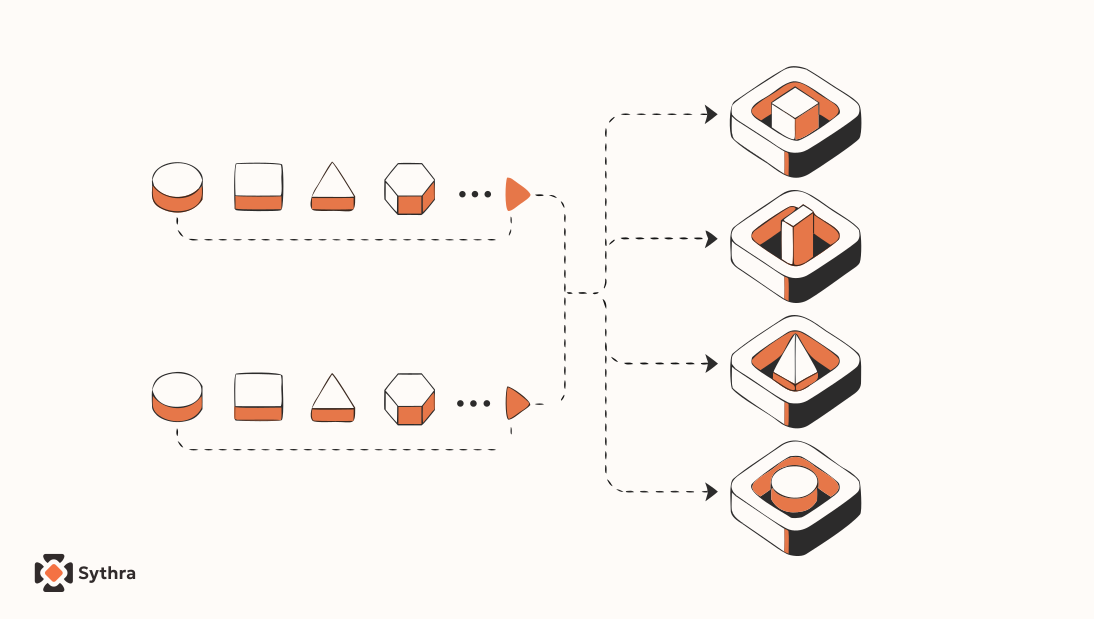
Feature engineering is the process of creating, transforming, and selecting input variables (called features) from raw data columns to help machine learning models discover meaningful patterns and make significantly more accurate predictions.
Think of it like a professional chef preparing a meal: throwing raw, unwashed, whole vegetables directly into a cooking pot produces a rough, inedible dish. Feature engineering is the essential chopping, peeling, and seasoning step — reshaping raw data into clean, digestible ingredients your model can learn from.
Why It Is Used: Features Beat Complex Algorithms
A fundamental reality in applied machine learning is that the quality of your features matters far more than the complexity of your algorithm. A simple linear model trained on smart, engineered features routinely outperforms a deep neural network fed raw, noisy columns.
Raw datasets are rarely model-ready. A raw date of birth string like 1990-04-12 has zero mathematical meaning to an algorithm, whereas deriving age, day_of_week, or is_weekend provides clear, predictive signal.
The 4 Core Pillars of Feature Engineering
| Pillar | Objective | Standard Techniques | Practical Example |
|---|---|---|---|
| 1. Feature Scaling | Brings numeric variables to a common scale so large units do not dominate small units. | Standardization (-score), Min-Max Normalization . | Rescaling Annual Income ($150,000) and Age (28) to equal footing. |
| 2. Distribution Fixes | Stabilizes variance and pulls skewed long tails toward a bell curve. | Log Transformation (), Power Transforms. | Unskewing real estate prices where a few mansions distort the mean. |
| 3. Categorical Encoding | Converts text categories into numerical format without imposing fake ordinal relationships. | One-Hot Encoding, Ordinal Encoding, Target Encoding. | Encoding cities (Delhi, Mumbai, Chennai) into binary 0/1 indicator columns. |
| 4. Feature Creation | Extracts domain-driven signals and interaction ratios. | Datetime decomposition, interaction terms, Binning. | Calculating Income per Family Member by dividing Total Income by Household Size. |
Which Models Actually Need Feature Scaling?
Not all algorithms require feature scaling. Use this quick reference guide to avoid unnecessary preprocessing steps:
| Algorithm Family | Requires Scaling? | Why / Technical Explanation |
|---|---|---|
| Distance-Based (KNN, K-Means, SVM) | YES (Mandatory) | Calculates Euclidean distance (). Unscaled features dominate distances. |
| Gradient-Based (Linear/Logistic Reg, Neural Networks) | YES (Recommended) | Enables gradient descent to step smoothly without oscillating across asymmetric loss surfaces. |
| Tree-Based (Decision Trees, Random Forests, XGBoost) | NO | Trees make binary split decisions () on single features independently of scale. |
The Mathematical Foundations
1. Standardization (Z-Score Scaling)
Rescales a column so it has a mean () of 0 and a standard deviation () of 1. It is resilient against moderate outliers:
2. Min-Max Normalization
Compresses all data points into a strict bounded interval, typically between 0 and 1:
3. Log Transformation
Pulls extreme right-skewed tails inward toward a normal distribution. The prevents undefined errors:
Code: Step-by-Step Python Implementation
1. Setting Up the Sample Dataset
import pandas as pd
import numpy as np

# Sample realistic customer profile dataset
data = {
    "age": [22, 35, 58, 41, 29],
    "income": [25000, 60000, 120000, 85000, 40000],
    "city": ["Delhi", "Mumbai", "Delhi", "Chennai", "Mumbai"],
    "date_of_birth": pd.to_datetime(
        ["2002-03-15", "1989-07-22", "1966-01-10", "1983-11-05", "1995-09-30"]
    )
}

df = pd.DataFrame(data)
print(df)
2. Standardization (Z-Score Scaling)
From Scratch:
def standardize_from_scratch(col):
    mean = col.mean()
    std = col.std(ddof=0)
    return (col - mean) / std

df["income_std_manual"] = standardize_from_scratch(df["income"])
print(df[["income", "income_std_manual"]])
Scikit-Learn Version:
from sklearn.preprocessing import StandardScaler

scaler = StandardScaler()
df["income_standardized"] = scaler.fit_transform(df[["income"]])
print(df[["income", "income_standardized"]])
3. Min-Max Normalization
From Scratch:
def minmax_from_scratch(col):
    return (col - col.min()) / (col.max() - col.min())

df["age_norm_manual"] = minmax_from_scratch(df["age"])
print(df[["age", "age_norm_manual"]])
Scikit-Learn Version:
from sklearn.preprocessing import MinMaxScaler

minmax = MinMaxScaler()
df["age_normalized"] = minmax.fit_transform(df[["age"]])
print(df[["age", "age_normalized"]])
4. One-Hot Encoding
# Option A: Quick Pandas get_dummies
city_dummies = pd.get_dummies(df["city"], prefix="city")

# Option B: Scikit-Learn OneHotEncoder (Best for Pipelines)
from sklearn.preprocessing import OneHotEncoder

encoder = OneHotEncoder(sparse_output=False)
city_encoded = encoder.fit_transform(df[["city"]])
city_df = pd.DataFrame(city_encoded, columns=encoder.get_feature_names_out(["city"]))
print(city_df)
5. Log Transformation (Fixing Skew)
# Use np.log1p which safely computes log(x + 1)
df["income_log"] = np.log1p(df["income"])
print(df[["income", "income_log"]])
6. Discretization / Binning
df["age_group"] = pd.cut(
    df["age"],
    bins=[0, 19, 35, 60, 200],
    labels=["Teen", "Young Adult", "Adult", "Senior"]
)
print(df[["age", "age_group"]])
7. Feature Extraction From Datetime
today = pd.Timestamp("2026-08-28")
df["computed_age"] = ((today - df["date_of_birth"]).dt.days / 365.25).astype(int)
print(df[["date_of_birth", "computed_age"]])
Common Pitfalls & How to Avoid Data Leakage
- Fitting Scalers on Full Dataset: Never call
scaler.fit(X)before train-test split. Always runscaler.fit(X_train)and thenscaler.transform(X_test). - High-Cardinality One-Hot Explosion: One-hot encoding columns with thousands of unique categories (like zip codes) creates massive sparse matrices. Use frequency or target encoding instead.
- Target Leakage: Avoid creating features from variables that will not be available at inference time (e.g. including future payment status in a loan default model).
Summary
- Feature engineering transforms raw columns into high-signal inputs that boost model performance.
- Distance-based and gradient-based models require scaling; tree-based models do not.
- Log transforms stabilize variance in skewed data; one-hot encoding converts text to binary flags.
- Always fit all encoders and scalers strictly on training data.
Common questions
What is the difference between Standardization and Min-Max Normalization?
Standardization rescales data to have a mean of 0 and standard deviation of 1 (resilient to outliers), while Min-Max Normalization bounds all values between 0 and 1.
Do Decision Trees and Random Forests need feature scaling?
No. Tree-based models evaluate split thresholds on individual features independently, making them immune to monotonic scale transformations.
Why must scalers only be fit on training data?
Fitting a scaler on both train and test data leaks information (the test set mean and variance) into the training process, producing overly optimistic validation scores that fail in production.