
What Is Machine Learning? A Beginner's Guide
Machine Learning (ML) is a branch of Artificial Intelligence where computers learn to make decisions and predictions by finding patterns in data, rather than following pre-written, step-by-step rules.
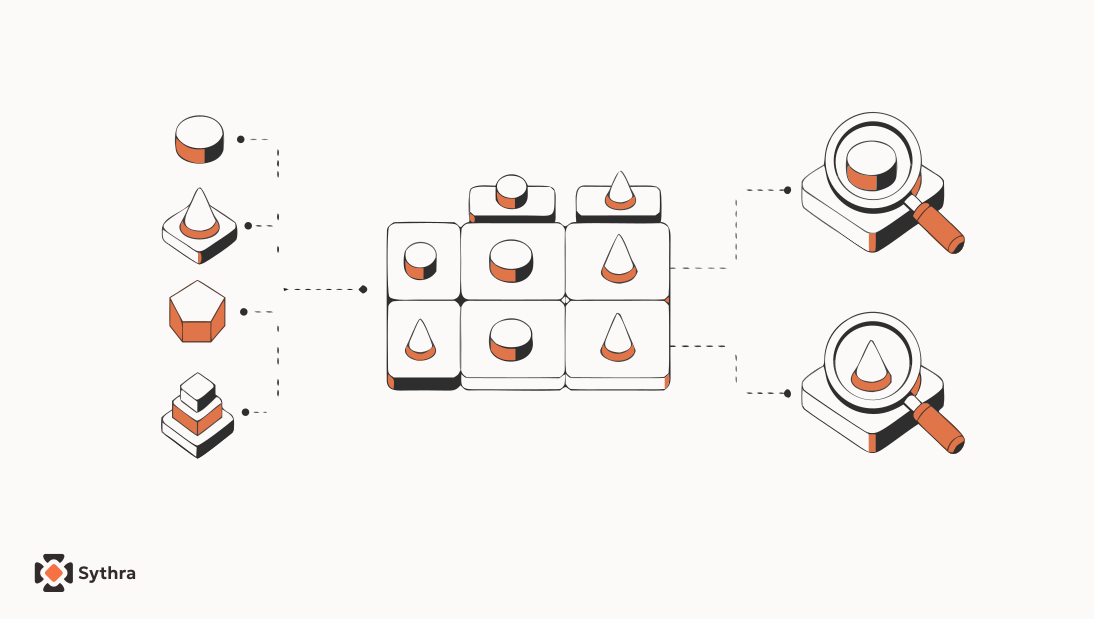
Machine Learning (ML) is a branch of Artificial Intelligence where computers learn to make decisions and predictions by finding patterns in data, rather than following pre-written, step-by-step human rules.
Instead of a programmer writing code for every imaginable scenario, you feed the machine historical examples, and the computer discovers the underlying logic on its own.
How Does It Work? The Child & Dog Analogy
Imagine teaching a child to recognize a dog. You don't hand them an encyclopedia definition: 'A dog is a quadrupedal canine with fur, specific ear shapes, and vocalizations between 50Hz and 2000Hz.' That would be incomprehensible.
Instead, you simply point at examples in the real world: 'Look, that's a dog. That's a dog too. That one is a cat.' After seeing a few dozen examples, the child naturally recognizes dogs they have never seen before — even a fluffy breed they've never encountered.
Machine learning works the exact same way: You provide thousands of labeled examples (called training data), and the algorithm continuously adjusts its internal parameters until it reliably spots the patterns separating one thing from another.
Traditional Programming vs Machine Learning
The easiest way to understand machine learning is to contrast it with classic software engineering:
| Traditional Programming | Machine Learning | |
|---|---|---|
| How it works | Human writes explicit rules (if/else logic) for the computer to follow | Computer figures out the rules automatically by studying thousands of examples |
| Inputs | Data + Human-Written Rules | Data + Desired Answers |
| Output | Answers / Results | A trained Model (the rules) |
| Best for | Clear, predictable tasks (e.g. calculating tax, payroll, banking transactions) | Complex, fuzzy tasks (e.g. recognizing faces, speech recognition, spam filtering) |
| Handling new edge cases | Requires a developer to manually write a new rule | Model updates its pattern as it sees more data |
Why It's Used: Problems Rules Can't Solve
Machine learning was created because certain real-world challenges cannot be solved with manual if/else conditions:
- Perception & Computer Vision: A digital image is just an array of millions of colored pixels. There is no manual formula that can describe every possible lighting condition, angle, and facial expression.
- Moving Targets (Spam & Fraud): When spammers realize the word 'free money' is blocked, they change it to 'fr33 m0ney'. Writing static rules is an endless game of whack-a-mole. ML looks at hundreds of subtle signals simultaneously to catch new variations automatically.
- Hyper-Personalization at Scale: Platforms like Spotify, YouTube, and Netflix serve hundreds of millions of users. No team of humans could manually curate custom recommendations for every individual daily.
Everyday Applications You Already Use
- Recommendation Engines (Netflix, YouTube, Amazon): Analyzing past behavior to predict which movie or product you will enjoy next.
- Voice Recognition & Translation (Siri, Alexa, Google Translate): Converting sound waves into text and accurately interpreting human language.
- Smart Navigation (Google Maps, Uber): Predicting live traffic congestion and estimated arrival times using real-time sensors and historical travel patterns.
- Facial Recognition (Apple FaceID): Instantly verifying identity even in dim lighting or with changes in appearance.
The Three Main Types of Machine Learning
| Type | How it Learns | Everyday Example |
|---|---|---|
| Supervised Learning | Learning with an answer key. You feed the model inputs along with known correct answers until it learns the pattern. | Predicting house prices from square footage, or filtering spam emails. |
| Unsupervised Learning | Learning without answers. The model discovers natural groupings, clusters, or hidden anomalies on its own. | Grouping e-commerce customers into purchasing segments based on browsing habits. |
| Reinforcement Learning | Learning through trial and error. The system takes actions in an environment and receives rewards for good moves and penalties for mistakes. | Training game-playing AI (like AlphaGo), autonomous drones, and robotics. |
Career Paths & Future Scope in Machine Learning
Machine learning has become the backbone of modern technology, creating immense demand across virtually every major industry. If you choose to learn ML, here is what the landscape looks like:
- In-Demand Career Roles: Machine Learning Engineer, Data Scientist, AI Application Developer, Computer Vision Specialist, and MLOps Engineer.
- High Industry Impact: Applied across Healthcare (early cancer detection, drug discovery), Finance (automated trading, algorithmic fraud prevention), Automotive (autonomous driving), and Generative AI (LLMs like ChatGPT).
- Future-Proofing Your Skills: As traditional repetitive software tasks become automated, engineers who understand how to train, evaluate, and deploy intelligent models are among the most valued in the tech ecosystem.
Your Recommended Learning Roadmap
- Step 1 — Python & Data Foundations: Learn basic Python syntax and libraries like NumPy (arrays) and Pandas (data tables).
- Step 2 — Core Machine Learning Concepts: Understand the difference between Supervised vs Unsupervised learning, and master the standard train-test workflow.
- Step 3 — Hands-On Modeling: Build regression and classification models using scikit-learn on real datasets.
- Step 4 — Advanced Topics: Explore Deep Learning, Neural Networks, and Generative AI once your core foundations are solid.
Key Terms Cheat-Sheet
| Term | What it means in plain English |
|---|---|
| Dataset | The collection of historical records or examples used to teach or test the computer. |
| Training Data | The specific portion of data shown to the model so it can discover patterns. |
| Features | The input clues (e.g. number of bedrooms, square footage, neighborhood). |
| Label / Target | The correct answer or outcome you want to predict (e.g. the final house sale price). |
| Model | The trained system resulting from learning that can now make predictions on brand-new data. |
| Inference / Prediction | The act of passing new, unseen inputs into your trained model to get an answer. |
Common Misconceptions
- "Machine Learning is the same as AI:" AI is the overarching vision of building intelligent systems. Machine Learning is the specific, data-driven technique used to build most modern AI.
- "Computers 'think' like humans:" A model that classifies cats does not know what an animal is. It simply detects statistical relationships in pixel numbers.
- "You need a PhD to get started:" Modern Python tools and libraries make building real, working machine learning applications accessible to anyone with basic coding curiosity.
Summary
- Machine learning teaches computers to discover patterns from data rather than following hand-coded rules.
- It solves perception and high-scale personalization problems where static logic fails.
- The core paradigms are Supervised (labeled answers), Unsupervised (pattern finding), and Reinforcement (rewards).
- Learning ML opens high-growth career opportunities across software, data science, and modern AI development.
Common questions
Is Machine Learning the same as AI?
No. AI (Artificial Intelligence) is the broad vision of creating intelligent machines. Machine Learning is the primary practical technique used to achieve AI by training algorithms on data.
How does Machine Learning differ from traditional programming?
In traditional programming, a software developer writes explicit if/else rules. In Machine Learning, the computer is shown thousands of examples and discovers the rules automatically.
What career paths are available in Machine Learning?
Learning ML opens roles such as Machine Learning Engineer, Data Scientist, AI Product Developer, MLOps Engineer, and Computer Vision Specialist across healthcare, finance, tech, and robotics.