
The Four Pillars of OOP in Python
The four pillars of Object-Oriented Programming are encapsulation (bundling data and behavior together), abstraction (hiding complexity behind a simple interface), inheritance (building new classes on top of existing ones), and polymorphism (the same action behaving differently depending on the object).
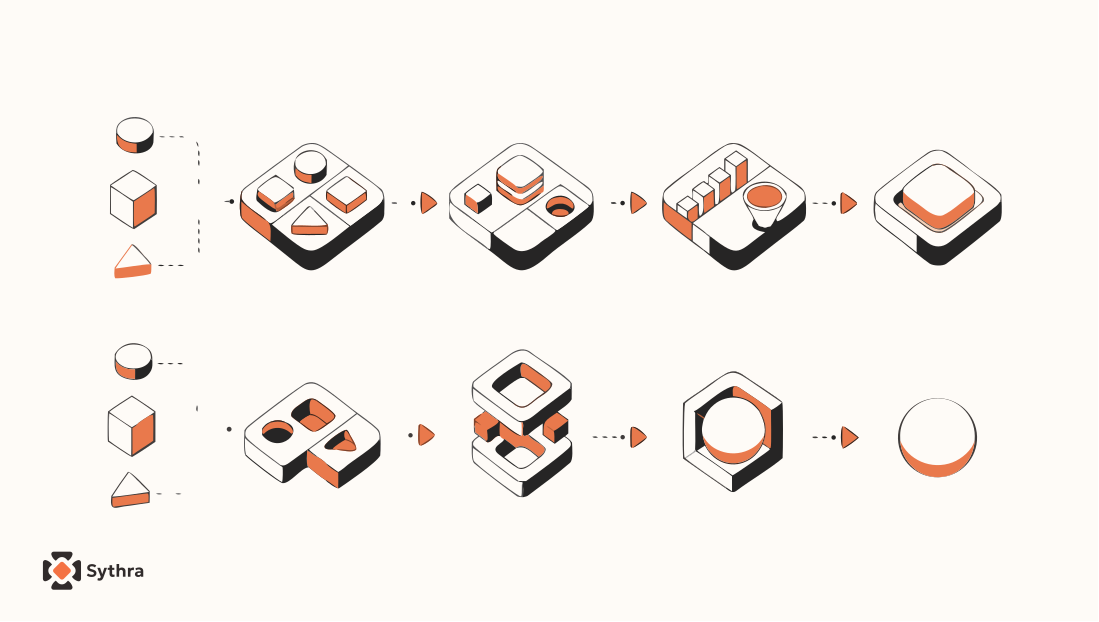
Up until now, you've been writing programs as a list of instructions — do this, then do that, check this condition, run this loop. That style is called procedural programming, and it's worked great for everything you've built so far.
But there's a different way to think about programs — one where instead of just writing instructions, you build little "things" that have their own data and their own behavior, and let those things interact with each other. This is called Object-Oriented Programming, or OOP. You've already had a taste of this in Classes and Objects and Classes and Methods. Now we go deeper, organized around four big ideas — the Four Pillars of OOP.
The four pillars, at a glance
- Encapsulation — bundling data and the actions that work on it together, inside one neat package.
- Abstraction — hiding the messy, complicated details, and showing only a simple, clean way to use something.
- Inheritance — letting one class borrow everything from another class, so you don't repeat yourself.
- Polymorphism — letting the same action behave differently depending on what kind of object it's acting on.
Don't worry if those sound abstract right now — that's completely normal. Let's build intuition for all four with one real-world example, with zero code, before diving into each separately.
A story to hold onto: the coffee machine
Imagine a coffee machine on your kitchen counter. Use it to understand all four pillars at once.
Encapsulation — everything it needs, bundled inside
A coffee machine has water, coffee grounds, a heating element, buttons, tubes, and wires. All of that — the stuff (data) and the actions it can do (boil water, grind beans, pour coffee) — is bundled together, inside one single object: the machine itself.
You don't carry water in one bag, grounds in another, and a heating coil in your pocket, assembling coffee by hand every morning. Everything related to "making coffee" lives together, in one self-contained unit. That bundling — data and behavior, packaged as one thing — is encapsulation. In code, it means putting related attributes and methods together inside a single class, instead of leaving them scattered loosely around your program.
Abstraction — you just press a button
Now think about how you actually use the machine. You press one button labeled "Brew." You don't need to know the exact voltage flowing into the heating element, or the temperature curve the water follows. That complicated machinery is hidden from you — you're given one simple interface, and everything underneath is none of your business.
That hiding of complicated internal details, while offering a simple way to use something, is abstraction. In code, a class can have wildly complicated logic inside it, but the person using the class only needs to know a few simple, clearly-named methods — they never peek inside.
Inheritance — building an espresso machine from a coffee machine
Now imagine your company wants a fancier product: an espresso machine. It does everything a regular coffee machine does — heats water, holds beans, has buttons — but also has a steam wand and a pressure pump. Would you build it completely from scratch? Of course not. You'd take the existing design and add the new espresso-specific parts on top.
That's inheritance — building a new class on top of an existing one, automatically getting everything the original already does, and only adding (or slightly changing) what's actually different.
Polymorphism — "Brew" means something different on each machine
Suppose you press "Brew" on a regular drip machine, and then a similarly-labeled "Brew" button on the espresso machine. The word is the same. But what happens underneath is completely different — one slowly drips hot water through a filter, the other forces pressurized water through packed grounds in seconds.
The same action — "Brew" — behaves differently depending on which object you're actually using. That's polymorphism: the same name, the same general idea, but different behavior depending on the specific object involved.
Why does any of this matter?
- Encapsulation keeps your code organized — related things stay together, making huge programs easier to navigate.
- Abstraction keeps your code simple to use — even if something is internally complicated, the user only sees a clean interface.
- Inheritance keeps your code from repeating itself — write something once, reuse it across many related classes.
- Polymorphism keeps your code flexible — one piece of code can correctly work with many different types of objects.
Together, these four ideas are the reason huge, real-world software systems — used by banks, hospitals, video games, and social media apps — don't collapse into an unmanageable mess as they grow. They let thousands of programmers, working on the same giant project, build small, well-organized pieces that fit together cleanly.
Where to go from here
Each pillar gets its own full, dedicated deep-dive — one at a time, with plenty of real code and examples:
- Encapsulation — bundling data and behavior together, and protecting an object's internal details from being messed with carelessly.
- Inheritance — building new classes on top of existing ones, parent and child classes, and how Python figures out which method to use.
- Abstraction — hiding complexity and exposing only what's necessary, including a look at abstract classes.
- Polymorphism — writing code that works correctly across many different types of objects, including operator overloading.
Each one builds naturally on the one before it, so that's the order to read them in.
Common questions
What are the four pillars of OOP?
The four pillars of Object-Oriented Programming are encapsulation, abstraction, inheritance, and polymorphism. Together they describe how classes bundle data with behavior, hide complexity, reuse code, and adapt behavior to different object types.
What is the difference between encapsulation and abstraction?
Encapsulation is about bundling an object's data and the methods that operate on it together, and protecting that data from invalid changes. Abstraction is about hiding complicated internal details and exposing only a simple, clean interface for using the object.
How is inheritance different from polymorphism?
Inheritance lets a new class reuse the code of an existing class, adding or overriding only what's different. Polymorphism lets the same method name or operator behave differently depending on which object it's actually called on — often enabled by inheritance, but a distinct idea.
Why does OOP matter for large programs?
OOP's four pillars keep large codebases organized (encapsulation), simple to use despite internal complexity (abstraction), free of duplicated logic (inheritance), and flexible enough to handle many object types with shared code (polymorphism).
Explore
Related topics
Keep going — these sit next to this concept in a real learning path.
Pillar One: Encapsulation in Python
@property, getters/setters, and protecting object invariants.
Pillar Two: Inheritance in Python
Parent/child classes with a Card, Deck, and Hand example.
Pillar Three: Abstraction in Python
Hiding complexity with abstract classes and @abstractmethod.
Pillar Four: Polymorphism in Python
Duck typing, operator overloading, and a full 4-pillar example.
Classes and Methods in Python
The methods foundation these four pillars build on.